Low-Dimensional Temporal Representations of Brain Functional Networks Using a Transformer-Based Autoencoder
May 1, 2025· ,·
0 min read
,·
0 min read
Qi Wang
Lin Du
et al.
Abstract
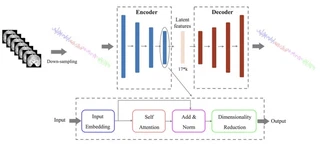
In this study, we developed a Transformer-based autoencoder (TAE) model for temporal dimensionality reduction of fMRI data, harnessing the Transformer’s ability to capture temporal dependencies and long-range relationships, alongside the deep autoencoder’s strength in effective dimensionality reduction and feature extraction. The low-dimensional representations extracted by the TAE preserve the integrity of the original temporal dynamics, demonstrating superior stability compared to traditional deep autoencoders and linear dimensionality reduction methods. Furthermore, TAE outperformed these methods in predicting cognitive scores. When applied to study symptoms in individuals with autism spectrum disorder (ASD), TAE revealed specific patterns associated with distinct symptom dimensions. Our work bridges low-dimensional temporal representations of brain functional networks with cognition and psychiatric symptoms, offering new insights and support for future advancements.
Type
Publication
17th International Conference on Bioinformatics and Biomedical Technology (ICBBT)

Authors
Research Scholar
lindu[at]fas.harvard.edu
ldu[at]mit.edu
lindu[at]fas.harvard.edu
ldu[at]mit.edu
Hi my name is Lin Du. I’m a Research Scholar affiliated with Department of Brain and Cognitive Sciences | McGovern Institute for Brain Research, MIT and Department of Psychology | Center for Brain Science, Harvard University. I’m advised by Nancy Kanwisher
and Randy Buckner.